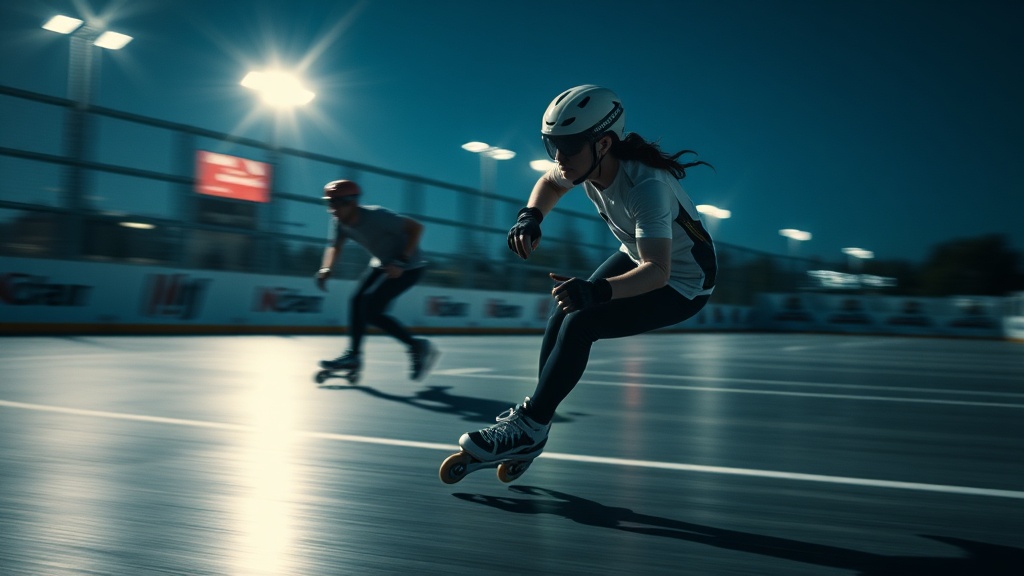
Why Your Core Strength Dictates Your Inline Skating Speed

The Core Myth: It’s All About the Legs
Most skaters assume that speed comes purely from the strength of their quads or the power of their glutes. They spend hours doing heavy squats or lunges, thinking that a bigger engine in the legs is the only way to go faster. They're wrong. While leg power provides the raw force, your core acts as the transmission that actually transfers that power to the ground. If your midsection is weak or unstable, you're essentially trying to drive a high-performance car with a slipping clutch. You might have a massive engine, but the energy is lost through a wobbly chassis. This post looks at why stability—not just raw power—is the real driver of efficiency on wheels.
When you're pushing off, your body undergoes intense lateral forces. If your abdominals and lower back aren't holding your torso steady, your hips will sway and your upper body will wobble. This instability leads to energy leaks. Every time your torso tilts or your hips dip, you're wasting a portion of the energy you just spent to make that stride. Instead of all that force moving you forward, it's being used to stabilize a collapsing frame. To get faster, you need to stop thinking about just legs and start thinking about a rigid, stable center.
Can Core Stability Improve My Skating Efficiency?
The short answer is yes, and it's more than just a fitness buzzword. Efficiency in inline skating relies on the ability to maintain a consistent center of gravity. When you're skating at high speeds or handling technical turns, your body is constantly fighting to stay balanced. A strong core keeps your pelvis level and prevents the unnecessary lateral movement that slows you down. If your pelvis isn't stable, your stroke becomes inconsistent. You'll find yourself fighting to stay upright rather than focusing on the next push.
Consider the physics of a single stride. As your leg extends outward and pushes back, it creates a rotational force on your torso. A strong core counteracts this force, keeping your upper body quiet and centered. This "quietness" is what separates professional skaters from amateurs. Professional skaters look effortless because their core absorbs the chaotic movements of the lower body, creating a stable platform. If you want to see real progress, look toward specialized training like the protocols suggested by the Strength and Conditioning Institute, which emphasizes functional stability over simple muscle size.
To build this stability, you shouldn't just do sit-ups. Sit-ups are a very limited movement for a skater. You need multi-planar movements—exercises that challenge you to stay stable while your limbs move in different directions. Planks, dead bugs, and rotational stability work are far more effective for the demands of the rink or the street. You're training your body to resist unwanted motion, which is exactly what happens during a high-speed skate-off.
Which Core Exercises Work Best for Inline Skating?
Not all core training is created equal. For skaters, we need to prioritize anti-rotation and lateral stability. If you only train your body to move in one direction, you'll struggle when the uneven pavement or a sharp turn throws you off-balance. Here are a few types of movement that actually matter for your discipline:
- Anti-Rotation: Think of the Pallof Press. This teaches you to resist being twisted by an outside force, which is vital when you're being bumped in a pack or handling a tight corner.
- Dynamic Stability: Exercises like the bird-dog or single-leg Romanian deadlifts force you to find balance while your center of mass shifts. This mimics the single-leg nature of the skating stride.
- Lateral Strength: Since skating is a lateral sport, your obliques need to be incredibly strong to prevent your hips from dipping during a stride. Side planks and side carries are great additions here.
By incorporating these, you're building a body that can handle the lateral stresses of the sport. You can find excellent guidance on movement patterns through resources like Penn Medicine, which highlights how core strength supports overall structural integrity. A stable core doesn't just make you faster; it makes you a safer skater by reducing the risk of falls caused by loss of balance.
Is a Weak Core the Reason I'm Losing Speed?
If you notice that your technique falls apart after twenty minutes of skating, the culprit is likely your core endurance. It's one thing to have a strong core for a single push, but it's another to maintain that stability over several miles. As your core muscles fatigue, your posture begins to slump. Your hips might drop, and your upper body might start to sway wildly. This isn't just a matter of looking bad; it's a matter of losing momentum. Once your form breaks down, your efficiency plummets, and you'll feel much more exhausted than you should be.
This is why endurance-based core work is so vital. You aren't just training for power; you're training for the ability to remain stable under fatigue. A tired core leads to a heavy, inefficient stride. If you feel yourself 'wobbling' or losing your line as the session progresses, it's a sign that your core stability hasn't been trained to endure the repetitive-lateral forces of skating. You need to build that muscular endurance so your 'chassis' stays rigid even when your legs are burning.
Think of it this way: your legs are the engine, but your core is the frame of the car. If the frame is bent or shaky, the engine's power is wasted. By focusing on stability and endurance, you ensure that every ounce of energy you put into your legs actually moves you forward. This shift in focus from purely leg-centric training to a more integrated, stable approach is what will eventually unlock your true speed potential.