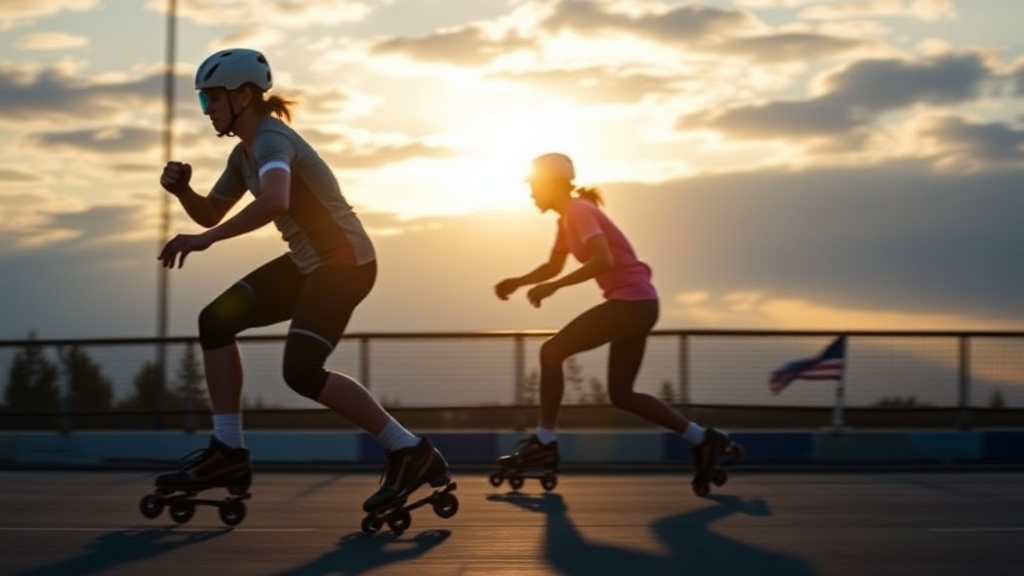
Building Muscle Endurance for Longer Inline Skating Sessions

This post explores how to develop the specific muscular endurance required to maintain high-intensity inline skating sessions without premature fatigue. You'll learn why traditional cardio isn't enough, how to structure strength training for repetitive motion, and how to target the specific muscle groups that dictate your stamina on the pavement.
Inline skating isn't just a cardio workout; it's a highly specific demand on your lateral stability and muscular endurance. While your lungs might feel fine, your legs often hit a wall long before your heart rate peaks. This happens because the repetitive, unilateral nature of the skating stride requires sustained tension in the glutes, abductors, and core. If these muscles fatigue, your form breaks down, your efficiency drops, and you're much more likely to suffer from an injury or a fall.
How do I build leg endurance for skating?
To build true endurance for the wheels, you need to move beyond steady-state running. You need resistance that mimics the push-and-recover cycle of a stride. One of the best ways to do this is through high-repetition strength training. Instead of lifting heavy weights for low reps, focus on moderate weights with high volume. This trains your muscle fibers to handle the lactic acid buildup that occurs during a long, fast-paced skate.
Exercises like lateral lunges and Bulgarian split squats are incredibly effective here. Since skating is essentially a series of single-leg movements, training your body to stabilize on one leg while the other moves is vital. You want to focus on the eccentric phase—the part where you are lowering yourself—because that controlled movement builds the stability needed for better edge control. If you want to see how physiological-based training cycles work, checking out resources like the ScienceDirect database for kinesiology research can provide deeper insight into muscle fatigue cycles.
The Role of Lateral Stability
Most people focus on their quads, but the real fatigue often starts in the hip abductors and the gluteus medius. When these muscles tire, your knees tend to cave inward—a phenomenon often called "valgus collapse." This isn't just bad for your speed; it's a recipe for knee pain. To prevent this, incorporate movements that challenge your lateral plane. Side planks and single-leg Romanian deadlifts are excellent tools for building that much-needed structural integrity.
Don't overlook the importance of the core. A weak core leads to a "wobbly" upper body, which forces your legs to work harder to maintain balance. When your core is stable, your energy is directed straight into the ground through your blades, rather than being wasted on stabilizing your torso. Think of your core as the bridge between your upper body and your lower body; if the bridge is shaky, the whole system suffers.
What are the best exercises for skating stamina?
If you're looking for a routine to implement, focus on a mix of plyometrics and isometric holds. Isometric holds—where you hold a position without moving—are fantastic for building the endurance of the stabilizing muscles. For example, holding a deep goblet squat position for 45 seconds can prepare your legs for the constant-tension demands of long-distance skating.
- Lateral Skater Bounds: These mimic the explosive side-to-side motion of skating and build explosive endurance.
- Step-ups: Excellent for building single-leg power and endurance in the glutes and quads.
- Plank Variations: key for maintaining a rigid, efficient upper body during high-speed sessions.
It's also worth noting that your recovery plays a role in how much you can train. If you're always training in a state of fatigue, your muscle endurance won't actually improve. You need to allow for the micro-tears in the muscle to heal. For more information on physical conditioning and the mechanics of movement, the National Federation of Coaches provides various perspectives on athletic development that are highly applicable to niche sports like ours.
Can I improve my skating by training differently?
Yes, and the secret often lies in the way you periodize your training. You shouldn't just do the same thing every week. If you want to see real progress, you need to cycle through phases: a strength phase, a power phase, and an endurance phase. During a strength phase, you lift heavier weights to build the foundation. During an endurance phase, you shift to higher reps and shorter rest periods to prepare for the actual demands of a long-distance skate.
A common mistake is neglecting the "unilateral" aspect. Many skaters train with two legs (like running or cycling), but skating is almost entirely about one leg at a time. If you only do bilateral exercises like standard squats, you might find yourself lacking the stability needed when your left leg is under heavy load. Always include single-leg work to ensure your body is balanced and capable of handling the asymmetrical nature of the sport.
Finally, remember that endurance is as much about the mind as it is about the muscles. Learning to breathe through the discomfort of a high-intensity interval is a skill in itself. When you feel that burning sensation in your quads, don't fight it with tension; instead, focus on maintaining your technical form. If your form stays clean, your efficiency stays high, and you'll be able to push much further than you thought possible.